bitig
bitig is a Python package and command-line tool for authorship attribution,
author-group style comparison and forensic authorship analysis. It covers the core
methods of R's Stylo (Delta, Zeta, PCA/MDS, clustering, bootstrap consensus trees,
classification) and adds a spaCy pipeline, transformer embeddings, a Bayesian layer (PyMC),
authorship verification with likelihood-ratio calibration, and a case workflow with
chain-of-custody hashing and sealed reports.
The name is the Old Turkic word for writing or inscription, the kind cut into the 8th-century Orkhon stelae.
Architecture
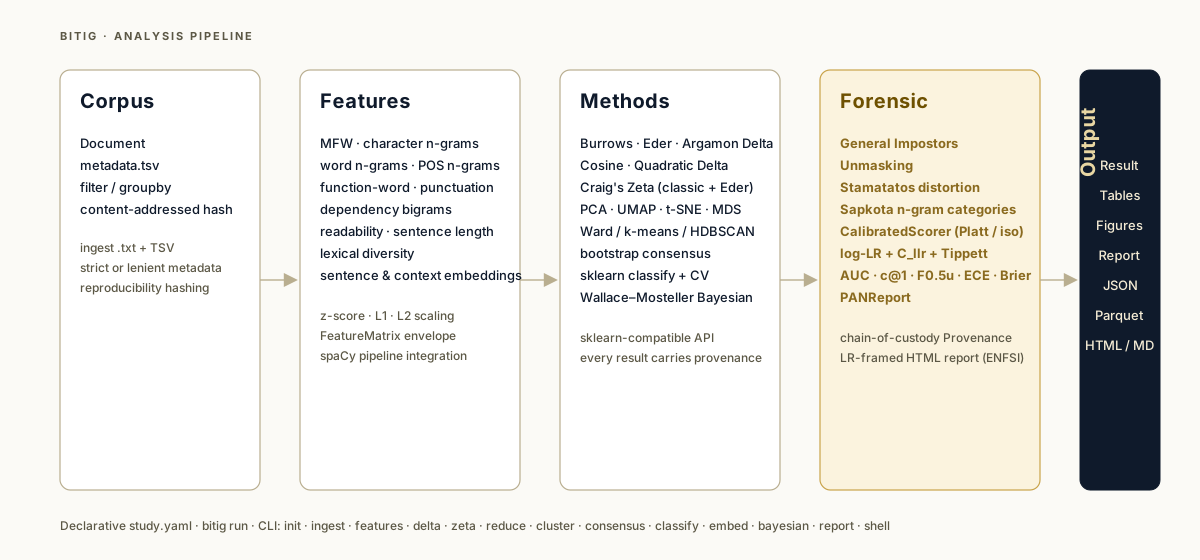
Feature extractors, the Delta classifiers and the Bayesian attributor are scikit-learn
estimators. Every Result carries its provenance (corpus hash, feature hash, seed, library
versions, timestamp, resolved config), so a study written as a study.yaml re-runs to the
same values given the same seed and library versions
(see Results & provenance).
Quick navigation
-
Getting started
Install bitig, build your first corpus, and run a Burrows Delta study from the CLI.
-
Concepts
Corpus → Features → Methods → Results. The four layers of the pipeline, explained.
-
Forensic toolkit
General Impostors and Unmasking verification, LR calibration, PAN evaluation, and the Forensic Lab case workflow.
-
Tutorials
Follow Mosteller & Wallace on the Federalist Papers, run PAN-style verification end to end, and analyse Turkish prose.
What's included
| Layer | Contents |
|---|---|
| Corpus | .txt + TSV metadata, filtering and grouping, a corpus hash that binds each text to its id and metadata |
| Features | most frequent words, character / word / POS n-grams, dependency bigrams, function words, punctuation, sentence length, readability (6 English indices plus native Turkish, German, Spanish and French formulas), 8 lexical-diversity indices, sentence and contextual embeddings |
| Methods | Burrows, Eder, Eder Simple, Argamon, Cosine and Quadratic Delta; Zeta (classic, Eder); PCA, MDS, t-SNE, UMAP; Ward, k-means, HDBSCAN; bootstrap consensus trees; sklearn classifiers with stylometry-aware cross-validation (stratified, leave-one-author-out, leave-one-text-out); Bayesian Wallace–Mosteller and hierarchical group comparison |
| Forensic | General Impostors and Unmasking verification; Sapkota character n-gram categories and Stamatatos text distortion for topic robustness; Platt / isotonic calibration to log-LRs; C_llr, AUC, c@1, F0.5u (PAN definitions), ECE, Brier, Tippett data; LR-framed HTML report with the two-sided verbal scale of Nordgaard et al. (2012), as adopted by ENFSI (2015); a case workflow with custody hashing and sealed reports (Forensic Lab) |
| Languages | English, Turkish, German, Spanish, French: per-language function words, readability and embedding defaults; Turkish parsing through Stanza (BOUN treebank) |
| Output | result.json + Parquet tables + figures per method; HTML / Markdown reports; PDF export of case reports (bitig[reports]) |
The documentation is in English and Turkish (/tr/).
Status
The latest release on PyPI is 0.3.1 (pip install bitig). main carries unreleased
changes, several of which change results or behaviour (case seals, General Impostors
defaults, calibration, PAN metrics, feature scaling).
CHANGELOG.md lists them,
marked [results] and [breaking].
License & citation
BSD-3-Clause. See LICENSE.
If you use bitig in published work, please cite it via
CITATION.cff.